
Grade Levels
MNTS Tamil School structures its curriculum in alignment with the ACTFL (American Council on the Teaching of Foreign Languages) proficiency scale — the national standard for language education in the United States. Every MNTS grade level maps to a specific ACTFL benchmark, ensuring students build skills systematically from introduction through Advanced Low proficiency.
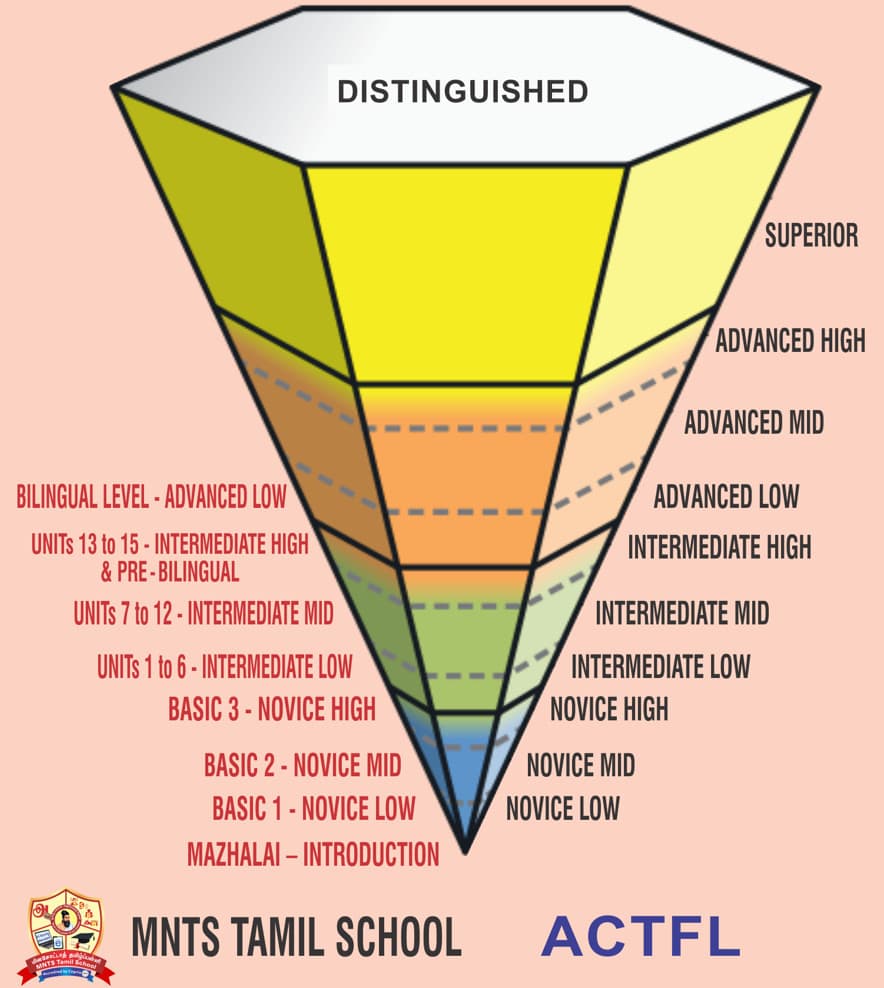
MNTS grade levels (left, in red) mapped to ACTFL proficiency benchmarks (right). The pyramid represents increasing language proficiency from bottom to top.
Grade Level Summary
Youngest learners. Develops listening and speaking through structured play and song.
Reading Tamil alphabets and words using the Nasan Ayya 32-card system. Writing basics.
Reading and writing all words with Nasan Ayya cards. Building vocabulary through Quizlet.
Consolidating reading and writing skills. 3-semester textbooks and 24 weekly homework PDFs.
Unit-based approach. NCSSFL can-do statements for LSRW. IPA assessments. Covers Units 1, 2 & 3 (first half) and Units 4, 5 & 6 (second half).
Unit-based approach. Real-world scenarios. Graded K–12 grammar. Covers Units 7–9 and Units 10–12.
Advanced unit-based curriculum. Students prepare for the Bilingual (Advanced Low) level. Covers Units 13–15 and Units 16–18.
Highest MNTS level. Graduates are eligible for the Tamil Bilingual Seal recognised by the Minnesota Department of Education.
The American Council on the Teaching of Foreign Languages (ACTFL) proficiency guidelines describe what individuals can do with language in terms of speaking, writing, listening, and reading. MNTS uses these benchmarks to set clear learning targets at each level and assess student progress through Integrated Performance Assessment (IPA) methodology. Proficiency levels range from Novice through Distinguished, with MNTS currently offering instruction up to Advanced Low.